

Choosing Led Solar Lights Outdoor in 2026 requires more than comparing brightness and price. Outdoor lighting now combines improved photovoltaic panels, efficient LEDs, smarter controls, and stronger weather protection. Yet product pages often hide important details. A lamp may advertise 1,000 lumens, but that figure can describe a brief peak mode. Battery capacity, winter sunlight, shade, and motion settings may matter more. I have tested solar fixtures around paths, driveways, patios, and garden walls. Small differences became obvious after several cloudy evenings. Some lights looked impressive on day one. They disappointed later. This experience shapes the practical advice in this guide.
The discussion will explain how to assess lumen claims, panel placement, battery chemistry, charging time, runtime, sensing distance, and IP ratings. It will also compare installation height, beam direction, color temperature, and maintenance needs. Reliable choices should match local weather, available sunlight, and the area’s actual purpose. A decorative light cannot replace security lighting. A powerful model may create glare instead of useful visibility. Check independent testing when available, and read warranty terms before purchasing. Standards and product specifications can change, so verify current information from manufacturers and recognized safety organizations. No buying guide is perfect. Real yards are untidy. Trees grow, panels collect dust, and winter clouds interfere. Therefore, this 2026 overview emphasizes transparent specifications, realistic expectations, and safer decisions rather than exaggerated promises. It is designed to help readers select durable Led Solar Lights Outdoor with confidence, while recognizing that the cheapest option is not always the most dependable.
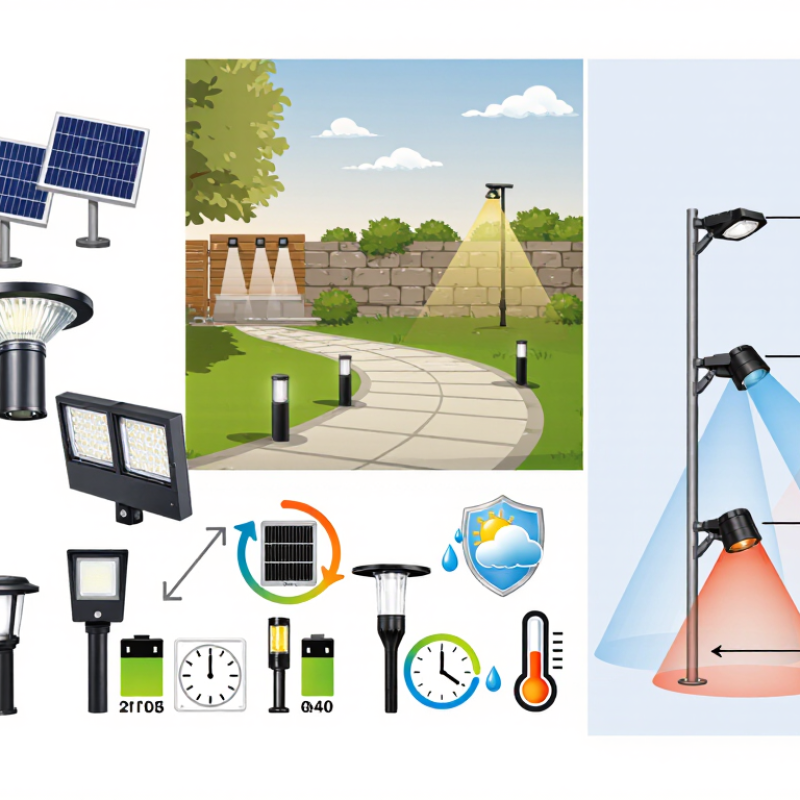
Outdoor LED solar lights combine photovoltaic cells, a rechargeable battery, LEDs, and control electronics. During daylight, the panel converts sunlight into electrical energy. The battery stores that energy for nighttime use. A light sensor usually turns the LEDs on automatically after dusk.
The panel needs direct sunlight, not just bright outdoor shade. Six hours of strong sunlight can improve nighttime performance, although cloudy weather reduces charging. Check the battery type, capacity, and expected runtime before purchasing. Lithium batteries often provide stable performance, but cold temperatures can reduce their output. LEDs consume little energy and usually produce clear, focused illumination. Warm white light suits patios, while cooler light can improve path visibility.
Installation details matter. Place the panel away from roof shadows, tall fences, and dense leaves. Keep the LED housing protected from rain, dust, and accidental splashes. An IP rating helps indicate this protection, but it does not guarantee perfect performance forever. A motion sensor can save energy, yet frequent activation may shorten nighttime lighting. Think about that trade-off.
Small tests help. Leave the light outside for several nights. Observe charging, brightness, and sensor timing. One overlooked problem is winter positioning. The lower sun may sit behind a wall, even when summer performance was excellent. Specifications are useful, but real conditions can disagree. That is where careful adjustment becomes necessary.
Choosing LED solar lights outdoors starts with the task, not the fixture. Paths need gentle guidance, while entrances need clear facial visibility and door-lock illumination. Gardens usually benefit from low, wide light. Sheds, steps, and bins require brighter, focused output. The U.S. Department of Energy notes that LED products commonly deliver over 100 lumens per watt, but solar performance also depends on panel exposure, battery capacity, and temperature.
Consider places where wiring is expensive, disruptive, or unreliable. A north-facing wall under dense trees may receive little winter sunlight. That is a practical warning. On-site observation matters more than a product photo. For a walkway, place lights near bends and level changes, leaving dark gaps small enough to avoid confusing depth. Motion sensors suit occasional security checks. Steady illumination works better beside frequently used doors.
Lighting demand is also an energy question. The International Energy Agency’s Energy Efficiency 2023 report estimates that lighting uses about 15% of global electricity consumption. Solar fixtures can reduce grid demand, but only when their operating hours match available charging. For a shed used after sunset, check the battery’s advertised runtime at low temperatures, not only laboratory conditions. For wet locations, verify an appropriate IP rating. Outdoor Research reports and field trials repeatedly show that glare, poor placement, and insufficient winter charging weaken real-world satisfaction. I would not oversize every fixture; excessive brightness can create harsh shadows and waste stored energy.
Use this planning table to match an outdoor space with the appropriate solar-lighting task, brightness, operating schedule, installation height, and protection level. The figures are practical planning ranges rather than a substitute for a site-specific lighting design.
| Outdoor Space | Main Lighting Task | Recommended Solar Fixture | Typical Brightness | Useful Illuminance Target | Recommended Mounting Height | Suggested Operating Pattern | Recommended Protection | Key Selection Considerations |
|---|---|---|---|---|---|---|---|---|
| Pathways and Walkways | Guide pedestrians and reduce trip hazards | Bollard light Low-level path light | 100–300 lm per fixture | 5–10 lux on the walking surface | 0.4–1.0 m | Automatic dusk-to-dawn or 6–10 hours nightly | At least IP44; IP65 for exposed locations | Use even spacing and shielded optics to limit glare. Place fixtures so light overlaps along the route. |
| Front Doors and Entry Steps | Facial recognition, key handling, and step safety | Wall light Compact downlight | 300–800 lm per fixture | 10–20 lux around the entrance | 1.8–2.4 m | Dusk-to-dawn or motion-activated boost mode | IP44 minimum; IP65 where rain exposure is high | Choose a warm or neutral white source, preferably with downward shielding to avoid direct eye glare. |
| Driveways and Carports | Vehicle movement, parking, and pedestrian visibility | Solar floodlight Area light | 800–2,000 lm per fixture | 10–20 lux in vehicle and pedestrian zones | 2.5–4.0 m | Low standby level with motion-activated high output | IP65 or higher | Use a wide beam for open areas and a narrower beam for long driveways. Avoid aiming light toward roads or neighboring windows. |
| Gardens and Planting Beds | Accent planting, define borders, and create visual depth | Stake light Adjustable spotlight | 50–300 lm per fixture | Low accent lighting; commonly 1–5 lux on nearby surfaces | 0.3–1.5 m | 4–8 hours after sunset | IP44 minimum; IP65 for permanent exposed installation | Prioritize beam control and color appearance over maximum lumen output. Avoid shining light directly into bedrooms or wildlife habitat. |
| Patios and Decks | Dining, conversation, and general outdoor activity | Wall lantern String or decorative light Downlight | 300–1,000 lm per functional fixture | 10–20 lux for general activity | 1.8–3.0 m | Manual control, timer, or 5–8 hours nightly | IP44 in sheltered areas; IP65 in fully exposed areas | Combine several low-output fixtures rather than one harsh source. Check that the panel receives unobstructed daytime sunlight. |
| Outdoor Stairs and Sloped Routes | Highlight tread edges, landings, and changes in level | Step light Recessed wall light | 50–200 lm per step or landing fixture | 10–20 lux on treads and landings | 0.2–1.0 m above the tread or adjacent wall | Dusk-to-dawn or motion activation | IP65 recommended; use impact-resistant housing | Install light where it reveals the step surface without creating strong shadows or glare. Keep wiring-free products securely anchored. |
| Security Zones and Side Yards | Detect movement and improve visibility near vulnerable access points | Motion-sensor floodlight Wide-angle wall light | 800–2,500 lm during activation | 15–30 lux during an active event | 2.5–4.0 m | Standby mode plus 30–120 second motion activation | IP65 or higher | Check sensor range, detection angle, false-trigger resistance, and the ability to adjust the light direction. |
| Garages, Sheds, and Utility Areas | Task lighting for access, storage, and minor maintenance | Solar wall light Remote-panel area light | 500–1,500 lm per work area | 20–50 lux for light maintenance tasks | 2.0–3.5 m | Motion activation or scheduled 4–8 hour operation | IP65; higher protection for wash-down locations | A remote solar panel is useful when the building wall or roof is shaded. Select a broad, uniform beam for close work. |
| Fences, Gates, and Boundaries | Mark property edges and improve orientation | Fence-post light Compact wall light | 50–250 lm per fixture | 2–10 lux around the boundary | 1.2–2.5 m | Dusk-to-dawn or low-level nighttime mode | IP44 minimum; IP65 for exposed gates and fences | Use downward or shielded distribution. Maintain consistent spacing rather than concentrating brightness at one point. |
| Signs, House Numbers, and Wayfinding | Make identification information readable after dark | Sign light Small directional spotlight | 100–400 lm per sign or identification point | Approximately 10–20 lux on the sign face | 1.5–3.0 m | Dusk-to-dawn or timer-controlled operation | IP44 minimum; IP65 for fully exposed installations | Use a diffuse beam and avoid reflections from glossy sign surfaces. Confirm that text remains legible from the approach direction. |
| Remote Garden Paths and Rural Areas | Basic orientation where grid power is unavailable | Standalone solar bollard Solar area light | 200–800 lm per fixture | 3–10 lux on the route | 0.8–2.5 m | Reduced-output mode with motion-activated boost | IP65 or higher | Allow extra battery capacity or reduced brightness for winter and overcast conditions. Prefer replaceable battery designs where practical. |
| Large Open Areas and Small Car Parks | General area visibility and pedestrian movement | Solar pole light High-output area light | 2,000–8,000 lm per pole or fixture | 5–20 lux depending on traffic and safety needs | 3.0–8.0 m | Photocell control with dimming and motion boost | IP65 or higher | Use a photometric layout for pole spacing, uniformity, glare control, wind loading, and battery performance before installation. |
How to Choose LED Solar Lights Outdoor in 2026?
Brightness, battery capacity, and solar performance decide whether outdoor lights remain useful after sunset. Start with lumens, not appearance. Pathway lighting often needs 100–300 lumens, while security areas may require 600 lumens or more. However, higher brightness usually consumes more stored energy. Check the claimed runtime at the selected brightness, not only the maximum lumen figure.
Battery capacity is commonly listed in milliamp-hours, but watt-hours offer a fairer comparison. Multiply voltage by amp-hours to estimate usable energy. A 3.7-volt, 4,000 mAh battery stores about 14.8 watt-hours before losses. My early mistake was choosing a large battery without checking charging time. It performed poorly during several cloudy winter days. Panel size, sunlight exposure, and charging efficiency matter together.
Tips: Place the panel where it receives direct midday sunlight. Avoid tree shade, walls, and dusty surfaces. Look for replaceable batteries and weather-resistant construction. Test the light for three nights before fixing it permanently. Also, treat runtime claims carefully; manufacturers may measure them in mild conditions. A slightly dimmer setting can provide steadier light and extend battery life. There is no perfect specification. Local weather still decides much of the result.
When choosing outdoor LED solar lights in 2026, weatherproofing should come before brightness. Look for a tested IP65 rating or higher, which helps resist dust and water jets. However, an IP rating does not guarantee protection from flooding or poor installation. Check the housing, seams, and charging panel for tight, even seals. Condensation inside the lens is a warning sign.
Materials also affect long-term performance. UV-stabilized polycarbonate resists yellowing, while aluminum sheds heat more effectively. Stainless steel screws are useful near coastal air, where ordinary metal may rust quickly. Choose a replaceable battery when possible. Batteries often fail before the LEDs. In my experience, even good lights perform poorly under tree shade or winter cloud cover. I once placed a light beneath dense branches and ignored the charging problem. That was a mistake.
Tips: Install the panel where it receives several hours of direct sunlight. Keep the fixture above standing water and angle it slightly downward for drainage. Tighten brackets firmly, but do not crush plastic housings. Clean dust and bird marks from the panel every few months. Test the light after heavy rain. A higher price can indicate better materials, but it is not proof of durability. Check the warranty, repair options, and battery specifications before buying.
What weatherproofing, materials, and installation features matter most?
Check the complete IP rating, sealed joints, drainage paths, and a protected charging connector. A higher IP rating does not replace correct installation or regular cleaning.
Look for UV-stabilized polycarbonate or other outdoor-rated polymers, corrosion-resistant aluminum or stainless-steel hardware, and a tempered or impact-resistant lens.
Choose an adjustable solar panel, secure mounting hardware, adequate sunlight exposure, and easy battery access. Avoid shaded locations and install the light where water cannot pool.
IP code descriptions are based on IEC 60529 protection classifications. The chart compares the numerical solid-particle and water-protection digits only.
Choosing outdoor LED solar lights in 2026 requires more than comparing brightness. Smart controls should match the site. Motion sensors can raise output when people approach, then dim during quiet hours. Photocells should prevent daytime operation. Remote monitoring is useful for large properties, but unnecessary for a small garden. Keep it simple. The U.S. Department of Energy reports that LED lighting can use at least 75% less energy than incandescent lighting and last up to 25 times longer.
Maintenance determines real value. Look for replaceable batteries, sealed housings, accessible panels, and clear fault indicators. An IP65 rating protects against dust and water jets, according to IEC 60529, but it does not guarantee performance after years of heat, dirt, or freezing weather.
The International Energy Agency’s Renewables 2024 report recorded about 420 gigawatts of new solar photovoltaic capacity in 2023, showing the technology’s expanding scale. Yet small lighting systems still depend heavily on battery quality.
Calculate total ownership cost, not just purchase price. Compare expected battery life, replacement labor, winter runtime, warranty coverage, and usable lumens. Field installers often find that poorly positioned panels cause more failures than weak LEDs. I have also seen “smart” systems become frustrating when apps lose support. Data beats guesswork. A lower-cost light may win initially, but reliable controls and a serviceable battery can deliver better value over five years. Do not ignore imperfect installation; even excellent hardware performs poorly in deep shade.
USA / Americas
1507 Capital Ave, Suite 102
Plano, TX 75074
+1 (214) 838-7010
8:00am – 5:00pm (GMT-6)
Australia / Asia Pacific
503 Cross Keys Rd,
Cavan SA 5094
+61 8 7200 3909
9:00am – 5:00pm (ACDST)
© 2025 Green Frog Systems. | Privacy Policy | Terms & Conditions