


Temporary & Portable Solar Lighting

Top 10 City Plaza Fountains for Global Buyers

City Plaza Fountains can transform an ordinary public square into a memorable civic destination. For global buyers, visual appeal is only one purchasing consideration. Water performance, structural durability, energy use, and maintenance access matter equally. This guide presents ten notable fountain types and destinations for commercial, municipal, and hospitality projects. Each example is considered through practical buying criteria, including climate suitability, visitor safety, local regulations, and long-term operating costs. The most impressive design may not suit every location.

Successful fountain procurement begins with detailed site knowledge. Buyers should review available water quality, seasonal temperatures, wind exposure, drainage capacity, and electrical infrastructure. A compact interactive fountain may suit a busy retail plaza. A large musical installation may require stronger foundations, advanced controls, and trained technicians. Materials also deserve close attention. Marine-grade stainless steel, durable stone, reliable pumps, and accessible filtration systems can reduce future disruption. Small details matter.

This article also recognizes that rankings are never completely objective. Cultural expectations, budgets, and maintenance skills vary between markets. A fountain that performs beautifully in a dry climate may struggle in a freezing region. Some project assumptions may need revision after professional site surveys. That is not a weakness; it is part of responsible planning. Global buyers can use these ten examples as informed references, then confirm specifications with qualified engineers, landscape architects, manufacturers, and local authorities. The goal is not simply to purchase a spectacular centerpiece. It is to create a safe, resilient, and financially sensible public amenity that continues serving visitors for many years.
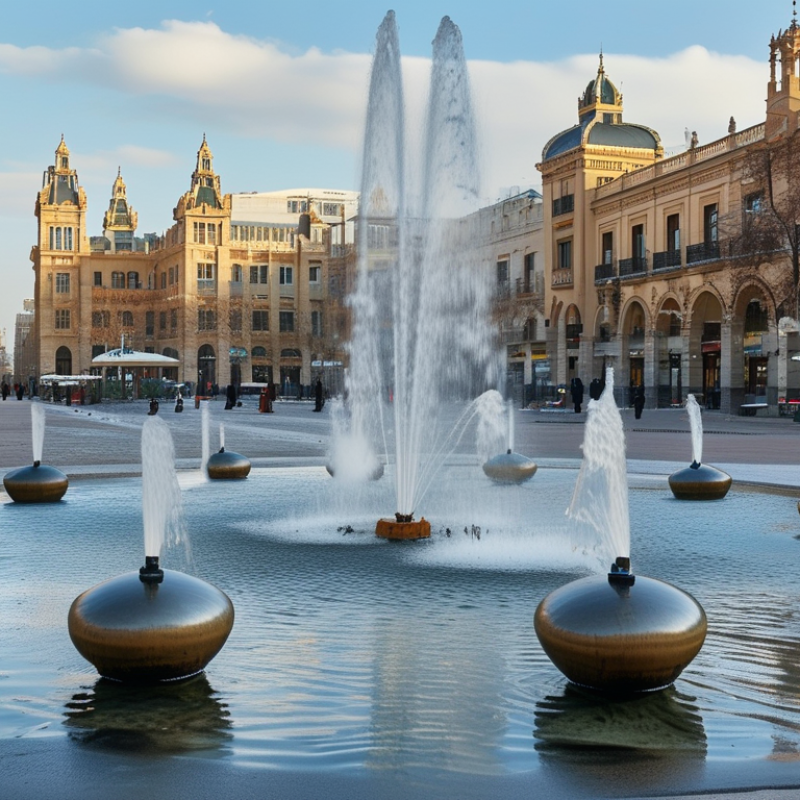
Top 10 City Plaza Fountains for Global Buyers

What Defines a City Plaza Fountain for Global Buyers

For global buyers, a city plaza fountain is more than an attractive water feature. It must work safely, economically, and reliably in public space. Buyers usually assess ten practical qualities: visual presence, hydraulic performance, material durability, energy use, water treatment, accessibility, noise control, climate suitability, maintenance access, and documented compliance. The best design supports daily life, not only opening-day photographs. Scale matters.

During a site review, professionals should check how spray height changes in wind and whether nearby paving becomes slippery. A fountain beside a transit stop needs clear walking routes, tactile guidance, and safe drainage. Stainless steel, stone, and coated concrete each respond differently to salt, heat, frost, and cleaning chemicals. Request pump curves, electrical diagrams, testing records, warranty terms, and a realistic maintenance schedule. Local technicians should reach filters, valves, lights, and control panels without closing the entire plaza. It sounds obvious. It is often overlooked.

Global purchasing also requires honest lifecycle costing. A low purchase price may hide high electricity use, frequent nozzle replacement, or complex winterization. Buyers should compare annual water consumption, filtration capacity, spare-part availability, and expected service intervals. Digital controls can improve timing, but they still need manual access when sensors fail. I would leave room for that failure. Weather, public behavior, and budgets rarely follow the original specification. A dependable city plaza fountain balances spectacle with restraint, measurable performance, and local operating reality.

How the Top 10 City Plaza Fountains Are Selected

Top 10 City Plaza Fountains for Global Buyers

How the Top 10 City Plaza Fountains Are Selected

A credible selection process begins with the plaza, not the photograph. We assess climate, visitor numbers, surrounding buildings, and available water infrastructure. A fountain that suits a dry public square may perform poorly in a freezing region. We also examine splash control, filtration, drainage, and safe walking surfaces. Beauty is not enough.

Each candidate receives a practical review across design, engineering, maintenance, and long-term cost. We study pump efficiency, replacement access, lighting durability, noise levels, and daily cleaning requirements. Accessibility matters, including clear routes for wheelchairs, children, and older visitors. Water quality procedures must be documented and easy for local teams to follow. We also check whether the design can meet local construction, electrical, and public safety requirements.

Evidence carries more weight than promotional language. Site plans, material specifications, maintenance records, and independent performance data help shape the ranking. We value fountains that remain attractive after heavy public use. Small details matter, such as concealed service panels and slip-resistant stone. However, the ranking cannot fit every city perfectly. Budget data may be incomplete, and public taste remains subjective. A visually dramatic fountain might still demand too much water or specialist maintenance. That weakness deserves honest attention before global buyers commit.

Top 10 City Plaza Fountains for Global Buyers

How the Top 10 City Plaza Fountains Are Selected

The selection considers public accessibility, historic and architectural significance, visibility in a major urban space, international visitor interest, and the availability of a documented inauguration year. The chart compares the number of years each fountain has been open to the public, calculated from its commonly documented inauguration year through 2026.

Reference basis: documented public opening or inauguration dates associated with the listed civic fountains and plazas. Dates may differ slightly when a fountain has undergone later reconstruction or redesign.

Design Features and Public-Space Functions to Compare

Top 10 City Plaza Fountains for Global Buyers

Comparing the top ten plaza fountains requires more than photographing the tallest jet. A strong design frames civic buildings, leaves clear walking routes, and offers shaded edges. UN-Habitat’s World Cities Report 2022 states that 56% of people lived in urban areas in 2021, with 68% projected by 2050. That growth makes flexible public space a practical investment, not decoration.

Look for adjustable spray heights, non-slip paving, concealed drainage, and separated maintenance access. Interactive basins can attract children, while shallow rills create quieter movement beside cafés and transit stops. The UN-Habitat Global Public Space Toolkit emphasizes accessibility, safety, and local identity. Ask whether wheelchair users can approach the water, and whether nighttime lighting avoids glare. Small details matter.

Water performance deserves hard questions. Compare recirculation rates, filtration capacity, make-up water, and annual cleaning hours. The U.S. Environmental Protection Agency’s WaterSense program identifies efficient fixtures and leak control as major water-saving measures, although plaza fountains need project-specific calculations. A supplier’s attractive render proves little. Request operating records, lifecycle costs, and climate testing. Some buyers still overvalue spectacle; impressive basins can fail when wind scatters spray across paving. That mistake is avoidable, but not always avoided.

Top 10 City Plaza Fountains for Global Buyers - Design Features and Public-Space Functions to Compare
Rank Fountain or Landmark City and Country Opening or Major Completion Verified Scale Indicators Key Design Features Public-Space Functions Useful Buyer Comparison Point
1 Jet d’Eau Geneva, Switzerland 1886; present location from 1951 Water plume reaches approximately 140 m high. Single landmark jet positioned on the lake edge; the moving plume is highly visible from the waterfront, bridges, and surrounding public spaces. Creates a strong civic identity, supports waterfront orientation, and provides a recognizable visual focus rather than a walk-through plaza feature. Best reference for evaluating long-distance visibility, wind exposure, safety zoning, and waterfront infrastructure.
2 Trevi Fountain Rome, Italy 1762 Approximately 26.3 m high and 49.2 m wide. Late Baroque architectural composition with sculptural figures, a theatrical central cascade, rockwork, and a large receiving basin. Acts as a destination landmark, supports pedestrian tourism, and anchors a compact historic urban space. Useful for comparing sculpture-led design, heritage integration, crowd management, and conservation requirements.
3 Buckingham Memorial Fountain Chicago, United States 1927 Main basin is approximately 85 m long and 37 m wide; central water display reaches about 46 m. Large formal basin with four sculptural groups representing the surrounding regional waterways and a timed choreographed display. Provides a ceremonial civic centerpiece, frames park views, and supports seasonal public events and evening illumination. Strong model for large parks requiring monumental scale, viewing distance, seasonal operation, and high-volume mechanical systems.
4 Magic Fountain of Montjuïc Barcelona, Spain 1929 Large terraced fountain complex with multiple pools, jets, lighting systems, and elevated viewing relationships. Axis-based composition combining classical forms, stepped basins, colored lighting, music, and programmed water movement. Supports tourism, night-time programming, ceremonial routes, and large public gatherings on a broad urban axis. Useful for assessing programmable displays, audience capacity, lighting coordination, sound control, and energy use.
5 Fountain of Wealth Singapore 1995 Main circular structure is approximately 66 m in diameter and about 13.8 m high. Large circular ring supported by sculptural columns, with a lower basin and a symbolic inward-flowing water concept. Serves as a gathering landmark, photo destination, pedestrian orientation point, and programmed public attraction. Good benchmark for ring structures, symbolic water narratives, tropical maintenance, and integration with mixed-use urban development.
6 King Fahd Fountain Jeddah, Saudi Arabia 1985 Water plume reaches approximately 312 m, making it one of the tallest fountain displays in the world. Single high-pressure seawater jet displayed against the Red Sea, with a deliberately simple form and exceptional vertical scale. Acts as a waterfront landmark, supports city branding, and creates a visual terminus for coastal views. Important reference for seawater systems, corrosion resistance, pump pressure, wind behavior, and restricted maintenance access.
7 Crown Fountain Chicago, United States 2004 Two glass-brick towers are approximately 15.2 m high; the plaza includes a shallow interactive water surface. Digital portraits are displayed on illuminated tower faces, while water emerges from openings near the mouth areas and spreads across the plaza floor. Encourages play, cooling, social interaction, public art engagement, and inclusive use across different age groups. Useful for comparing digital media, interactive water depth, slip resistance, drainage, public safety, and seasonal conversion to dry use.
8 Stravinsky Fountain Paris, France 1983 Basin area is commonly reported at approximately 580 square metres. Sixteen colorful kinetic sculptures reference musical themes, combining moving forms, jets, sprays, and shallow basin elements. Adds artistic character to a pedestrian square, supports informal seating and circulation, and creates a lively cultural foreground. A strong example for evaluating low-rise interactive sculpture, pedestrian safety, compact urban sites, and art-water coordination.
9 Friendship of Nations Fountain Moscow, Russia 1954 Large circular basin with a central sculptural composition and sixteen surrounding allegorical figures. Formal Soviet-era ensemble using gilded figurative sculpture, radial symmetry, central water jets, and strong axial views. Provides ceremonial symbolism, reinforces an exhibition-ground layout, and serves as a major visitor orientation point. Useful for comparing symbolic sculpture programs, radial planning, large visitor flows, and long-term restoration needs.
10 Downtown Lake Musical Fountain Dubai, United Arab Emirates 2009 Water display extends approximately 275 m; jets can reach about 150 m in height. Choreographed jets, mist, light, music, and multiple nozzle groups create layered horizontal and vertical movement across a lake. Supports evening tourism, retail-district foot traffic, event programming, and high-capacity viewing along surrounding promenades. Best reference for large programmed systems, high-density visitor viewing, lighting control, pump-room planning, and hot-climate operation.
Dimensions and dates are approximate figures widely reported for the listed public landmarks; final project comparisons should verify local drawings, operating specifications, water-treatment requirements, and current renovation status.

Materials, Safety Standards, and Maintenance Requirements

Top 10 City Plaza Fountains for Global Buyers

Materials, Safety Standards, and Maintenance Requirements

For global buyers comparing the top ten city plaza fountains, material selection should start with water chemistry. Marine-grade stainless steel resists corrosion, while dense stone reduces scratching and staining. However, porous stone can retain contaminants without proper sealing. The 2024 UNESCO World Water Development Report states that 2.2 billion people lacked safely managed drinking water in 2022. Decorative water should never be treated as drinking water. Clear signage and controlled access remain essential.

Safety requires more than attractive lighting. Designs should reduce standing water, sharp edges, slippery paving, and aerosol generation. The WHO Guidelines for Safe Recreational Water Environments identify microbial contamination and inhalation exposure as important risks around public water features. Buyers should request documented testing procedures, emergency shutoffs, anti-entrapment grilles, and electrical protection suited to wet locations. Local codes still decide final compliance. International standards are useful references, not automatic approval.

Maintenance access often decides whether a fountain succeeds. Filters, pumps, valves, and drains need reachable service panels, not concealed compartments beneath expensive paving. The CDC Model Aquatic Health Code provides practical benchmarks for disinfectant control and pH management, although ornamental fountains may follow different local requirements. Weekly inspection should check nozzles, water clarity, slip resistance, and pump noise. Monthly records should track chemical results and replacement parts. We once favored a cleaner hidden layout; servicing became slower and riskier. That design choice needs reconsideration. Fresh water use, energy demand, winterization, and spare-part availability should also appear in the purchasing specification.

Pricing, Customization, Installation, and Supplier Evaluation

Choosing among the Top 10 City Plaza Fountains requires more than comparing photographs. Pricing depends on basin size, nozzle count, lighting, control systems, and site conditions. A mid-scale interactive fountain may cost tens of thousands of dollars, while complex architectural displays can exceed several hundred thousand. Request an itemized quotation. It should separate equipment, freight, civil work, installation, testing, and maintenance.

Customization should match the plaza’s purpose. Quiet laminar jets suit civic spaces, while interactive sprays attract families and visitors. Ask for water-saving cycles, adjustable heights, non-slip paving, and concealed service panels. A good supplier provides hydraulic calculations, material samples, 3D drawings, and clear cleaning procedures. Small details matter. I once underestimated drainage capacity during an early project review. That mistake showed why site surveys must include rainfall, underground utilities, and electrical access.

Installation quality often determines long-term performance. Confirm who prepares the foundation, connects controls, balances pumps, and trains local staff. The supplier should explain commissioning tests in writing. Check previous projects, technical credentials, production capacity, response times, and warranty coverage. Ask for references from plazas with similar weather and visitor numbers. Reliable suppliers disclose lead times and likely replacement costs. Be cautious when a quotation looks unusually cheap. It may exclude filtration, wiring, protective housings, or after-sales support. A written maintenance schedule should identify weekly inspections, seasonal servicing, water treatment, and emergency procedures. Fancy renderings help, but measurable specifications deserve greater trust.

(214) 838-7010