


Choosing the right High Mast Street Light is more complex than comparing wattage or purchase price. Global buyers must consider road width, mounting height, climate, traffic flow, and maintenance access. A fitting that performs well on a coastal highway may fail early in a dusty industrial zone. Context matters.
This guide examines ten common high mast street light types used for highways, ports, airports, logistics parks, stadiums, and large urban roads. It considers LED performance, optical distribution, pole compatibility, wind resistance, corrosion protection, and control options. Practical evaluation should include verified photometric files, ingress protection ratings, surge protection, and credible warranty terms. Local engineers should also confirm illumination requirements and structural calculations before installation.
Small details matter. Lens quality affects glare. Cable access affects service time. A reliable supplier should explain testing methods, component origins, and expected maintenance intervals. Product brochures are useful, but they are not the whole story. Some claims may look impressive without showing real operating conditions. Buyers should request installation references and compare performance data carefully.
Not every listed type will suit every project. That is normal. Budget pressure can also encourage compromises that become expensive later. This article provides a practical starting point for comparing designs, rather than promising one universal solution. Careful site assessment remains essential for safe, efficient, and durable road lighting.
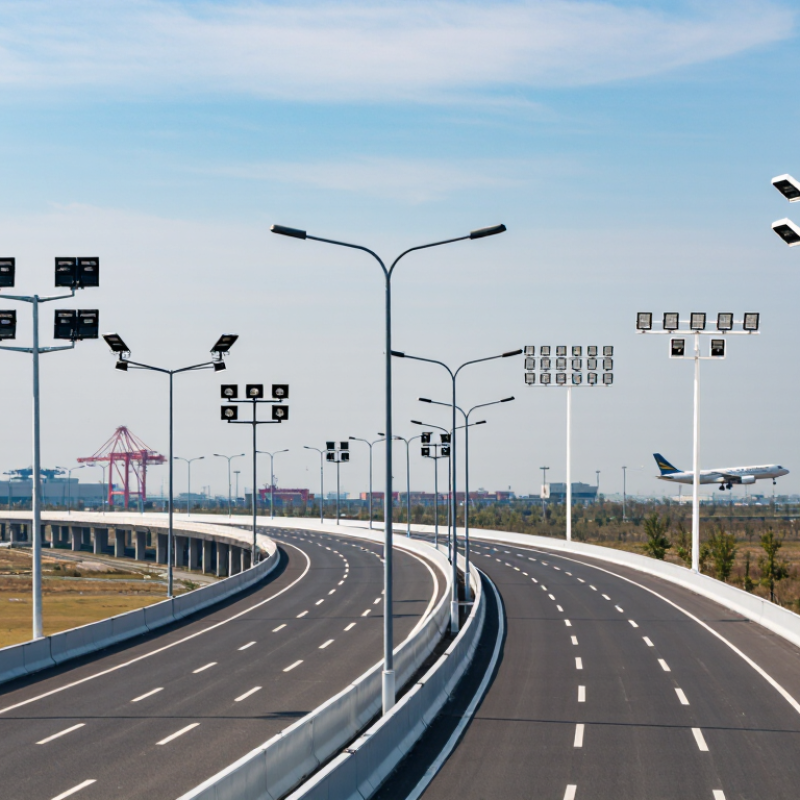
High mast street lights are tall outdoor lighting systems designed to cover wide areas from elevated mounting points. Their poles often rise 15 to 40 meters, with several LED luminaires installed near the top. One structure can illuminate roads, open yards, and transport zones with fewer poles. This arrangement reduces visual clutter and may simplify traffic planning. It also requires careful engineering.
These lights are commonly used along expressways, interchanges, ports, airports, logistics centers, and industrial yards. Large parking areas, sports grounds, and border transport facilities may also need them. At a busy intersection, broad light distribution helps drivers recognize lanes, vehicles, and roadside obstacles. Ports and storage yards benefit from fewer shadows between containers and loading equipment. Coastal locations need corrosion-resistant materials, while windy regions require accurate structural calculations.
Real-world selection depends on pole height, wind load, soil conditions, glare control, and maintenance access. LED optics should match the site, not simply provide maximum brightness. A narrow roadway may suffer from wasted light under an oversized system. Field inspections often reveal dark patches that computer layouts miss. That assumption deserves review. Poor aiming can disturb nearby homes, workers, or drivers. Regular cleaning, electrical checks, and lowering-system inspections support reliable operation, although maintenance planning is sometimes overlooked.
High mast street lights are commonly classified by design and application. The ten practical types include fixed-head, adjustable-head, ring-mounted, multi-arm, telescopic, floodlight, roadway, sports-field, airport-perimeter, and solar-hybrid systems. Fixed heads suit long roads with consistent lighting angles. Adjustable heads help engineers direct beams after installation. Ring-mounted designs spread light around large junctions or open yards. Multi-arm poles support several luminaires at different angles. Telescopic poles simplify maintenance in difficult locations.
Floodlight systems serve ports, construction yards, and industrial areas. Roadway models focus on uniform lanes and reduced glare. Sports-field systems need stronger vertical illumination for players and cameras. Airport and perimeter lights require controlled beams and careful visibility planning. Solar-hybrid units work in remote areas, but battery performance can drop during long cloudy periods. No classification is perfect. Local wind, dust, traffic speed, and maintenance access can change the best choice.
Tips: Check pole height, wind loading, corrosion protection, and photometric files before purchasing. A bright fixture is not always a good fixture. Confirm mounting diameter and lifting equipment on site. During field inspections, I have seen poorly aimed heads create dark patches beneath seemingly powerful poles. Recheck lighting levels after installation, especially near intersections and pedestrian crossings. Also consider future lamp replacement, because access costs may exceed the original fixture price.
Ten Main Types of High Mast Street Lights for Global Buyers
High mast street lights suit ports, airports, highways, interchanges, and large yards. The ten main types include fixed-head, raising-and-lowering, LED floodlight, modular LED, solar, hybrid solar-grid, smart-controlled, remote-monitoring, glare-shielded, and high-wind mast systems. Each design solves a different site problem. Fixed-head systems reduce mechanical complexity. Raising-and-lowering models simplify maintenance at 25–40 metres. Modular LED units support easier replacement after partial failure. Solar models work best where grid access is weak, but battery performance can drop sharply in cold or cloudy regions.
Energy performance deserves careful checking. The International Energy Agency reports that LED lighting can use around 50% less electricity than traditional lighting in suitable applications. The U.S. Department of Energy also identifies connected controls as a major route to further savings. However, real results depend on pole spacing, optics, dimming schedules, and maintenance. A bright installation is not automatically a good installation. I have seen projects over-light empty road edges while leaving pedestrian areas visually uncomfortable. That mistake is expensive.
Tips: Request an isolux plan, wind-load calculation, salt-spray protection, surge protection, and a realistic battery autonomy test. Ask for data at 25°C and at low temperatures. Check whether the stated lumen output is measured from the whole luminaire, not only the LED chip. Buyers should also verify local road-lighting standards, spare-part access, and control-system compatibility. One detail is often missed: glare shields may improve driver comfort but reduce useful coverage, requiring closer mast spacing.
| No. | High Mast Light Type | Typical Pole Height | Typical Luminaire Arrangement | Typical LED System Power | Recommended Light Distribution | Common Applications | Main Advantages | Key Buyer Considerations |
|---|---|---|---|---|---|---|---|---|
| 1 | Fixed-Crown High Mast Street Light | 20–45 m | 4–16 luminaires mounted on a fixed top frame | 600–3,200 W total | Asymmetric roadway or area-lighting optics | Urban arterial roads, interchanges, large junctions, industrial zones | Simple structure, low mechanical complexity, stable operation | Maintenance generally requires a lifting platform or service vehicle; confirm wind-load calculations and foundation design. |
| 2 | Raising-and-Lowering Crown High Mast Light | 20–40 m | 4–12 luminaires on a movable lowering ring | 600–2,400 W total | Roadway, forward-throw, or symmetrical floodlight optics | Airports, ports, highways, railway yards, logistics centers | Fixtures can be lowered to ground level for inspection and replacement | Check winch, cable, locking, grounding, and corrosion-protection requirements; mechanical maintenance is essential. |
| 3 | Ring-Crown High Mast Light | 18–35 m | 6–16 luminaires distributed around a circular ring | 900–3,200 W total | Wide symmetrical or medium flood distribution | Large roundabouts, public squares, container yards, open storage areas | Provides broad radial coverage from one central pole | Verify ring diameter, fixture tilt angles, structural loading, and uniformity at the site perimeter. |
| 4 | Multi-Arm High Mast Street Light | 15–30 m | 4–12 luminaires installed on separate radial or directional arms | 400–2,400 W total | Asymmetric forward-throw optics | Wide roads, complex intersections, bus terminals, commercial districts | Allows each luminaire to be aimed toward a specific roadway or zone | Arm geometry and aiming must be coordinated with road width, traffic direction, and glare limits. |
| 5 | LED Floodlight High Mast | 15–40 m | 2–12 independently adjustable floodlights | 300–3,000 W total | Narrow, medium, or wide beam floodlight optics | Ports, sports grounds, construction areas, industrial yards, emergency zones | High optical flexibility and strong illumination for large open areas | Review glare, spill light, beam angle, thermal management, and the required vertical illuminance. |
| 6 | Solar-Powered High Mast Street Light | 10–25 m | 1–8 LED luminaires with photovoltaic panels and battery storage | 80–800 W total | Asymmetric roadway or area-lighting optics | Remote roads, border facilities, off-grid yards, parks, temporary infrastructure | Reduced dependence on grid electricity and lower trenching requirements | Size the panel and battery for local solar radiation, autonomy days, temperature, dust, and seasonal weather. |
| 7 | Hybrid Solar-Wind High Mast Light | 12–25 m | 1–8 LED luminaires with solar panels, battery, and small wind turbine | 100–1,000 W total | Asymmetric roadway or controlled area-lighting optics | Remote highways, coastal sites, isolated compounds, off-grid transport areas | Combines two renewable energy sources to improve energy availability | Assess wind resource, turbine noise, vibration, storm protection, battery capacity, and maintenance access. |
| 8 | Smart-Controlled High Mast Street Light | 15–40 m | 4–16 individually dimmable LED luminaires | 400–3,200 W total | Programmable roadway, area, or floodlight optics | Smart cities, highways, ports, airports, industrial and logistics campuses | Supports scheduling, dimming, fault reporting, and energy monitoring | Confirm communication coverage, control protocol, cybersecurity, remote-monitoring platform, and manual override functions. |
| 9 | High-Wind-Rated High Mast Light | 20–45 m | 4–16 streamlined luminaires on a reinforced crown | 600–3,200 W total | Low-glare asymmetric or narrow floodlight optics | Coastal roads, bridges, airports, ports, exposed industrial sites | Designed for demanding wind environments and reduced structural movement | Specify the governing wind code, basic wind speed, terrain category, gust factor, corrosion class, and foundation conditions. |
| 10 | Decorative Architectural High Mast Light | 12–25 m | 2–12 luminaires integrated into a custom or architectural crown | 200–1,200 W total | Low-glare symmetrical, asymmetric, or façade-wash optics | City gateways, waterfronts, public plazas, landmark roads, civic areas | Combines large-area illumination with a coordinated architectural appearance | Balance visual design with photometric performance, maintenance access, wind loading, and long-term finish durability. |
High mast street lights include fixed, raising, lowering, ring, floodlight, roadway, solar-assisted, smart, airport, and stadium types. Global buyers should compare performance, not appearance alone. A typical system uses galvanized steel for the pole, aluminum for the LED housing, and tempered glass for the lens. Steel offers strength, while aluminum improves heat dissipation. The balance matters in coastal areas.
Specify the pole height, wind-load rating, outreach angle, and foundation requirements. LED modules should state wattage, delivered lumens, efficacy, color temperature, and color rendering index. For roads, 3000K to 5000K is common, but local glare limits may require a warmer option. Look for IP66 protection and suitable IK impact resistance. Surge protection, dimming control, and replaceable drivers also affect service life. A five-year warranty means little without testing records and spare-part access.
Relevant references may include IEC 60598-1, IEC 60598-2-3, IEC 60529, and IEC 62262. EN 40 can support structural pole design, while ISO 1461 relates to hot-dip galvanizing. Requirements differ by country, so certificates must match the installation market. Check photometric files, salt-spray evidence, thermal tests, and corrosion thickness. In project reviews, buyers often focus on lumens and miss wind data. That mistake is costly. Even accurate calculations need field verification, because dust, wet pavement, and nearby trees can change real illumination.
Typical LED system power by high-mast lighting application. Values are representative engineering ranges used for preliminary global buyer comparisons; final selection depends on lighting calculations, road geometry, wind load and local regulations.
| Lighting Type | Typical Mounting Height | Common Material | Typical Standard References |
|---|---|---|---|
| Fixed high-mast roadway light | 20–40 m | Hot-dip galvanized structural steel | IEC 60598-1, EN 40, CIE 115 |
| Raising-and-lowering high mast | 20–45 m | Galvanized steel with stainless-steel hardware | IEC 60598-1, IEC 60204-1, EN 40 |
| Interchange or freeway lighting | 25–45 m | Tapered galvanized steel | CIE 115, EN 13201, EN 40 |
| Airport and logistics-yard light | 20–35 m | Galvanized steel or aluminum luminaire housing | IEC 60598-1, CIE 150 |
| Port and container-terminal light | 25–50 m | Hot-dip galvanized steel, marine-grade coatings | IEC 60598-1, IEC 60529, CIE 150 |
| Sports-field high-mast light | 25–45 m | Galvanized steel with aluminum LED modules | EN 12193, IEC 60598-1 |
| Floodlighting high mast | 20–40 m | Steel mast with die-cast aluminum luminaires | IEC 60598-1, IEC 60529, CIE 150 |
| Solar or hybrid high-mast light | 10–25 m | Galvanized steel, aluminum and lithium battery enclosure | IEC 60598-1, IEC 62133, IEC 60529 |
| Smart dimming high-mast light | 20–40 m | Galvanized steel with aluminum LED housing | IEC 60598-1, IEC 62386, EN 13201 |
| High-wind coastal high mast | 25–50 m | Galvanized steel with corrosion-resistant fasteners | EN 40, IEC 60598-1, IEC 60529 |
Buyer note: LED high-mast systems commonly use aluminum housings, tempered glass lenses and galvanized steel poles. EN 40 addresses lighting-column structural design, EN 13201 covers road-lighting performance, IEC 60598-1 covers luminaire safety, and IEC 60529 defines IP protection ratings. Photometric calculations and wind-load verification should be completed before procurement.
The ten common categories include fixed floodlights, ring-mounted systems, multi-arm towers, sports lighting, port lighting, airport lighting, area optics, solar hybrids, mobile towers, and high-low masts.
Supplier evaluation should begin with photometric files, corrosion protection, wind-load calculations, and tested ingress ratings. Ask for independent reports, not marketing claims. IES or LM-79 test data can reveal beam performance and lumen maintenance.
Cost comparisons must include foundations, lifting equipment, cabling, controls, inspections, and replacement access.
The IEA’s Energy Efficiency 2023 report states that lighting uses about 15% of global electricity.
The U.S. Department of Energy reports that LED products can use at least 75% less energy and last up to 25 times longer than incandescent lighting.
However, high-mast savings depend on optics, dimming schedules, climate, and cleaning frequency.
Request a five-year total-cost model.
Include one failed driver and one storm repair.
Installation needs a geotechnical review, accurate wind data, and safe lowering equipment.
Maintenance teams should inspect bolts, coatings, surge protection, and cable seals during planned outages.
Choose suppliers offering spare parts for at least ten years.
A perfect payback model is rarely perfect.
Soil conditions change.
Delayed permits can also distort budgets.
Test one representative pole before ordering hundreds.
USA / Americas
1507 Capital Ave, Suite 102
Plano, TX 75074
+1 (214) 838-7010
8:00am – 5:00pm (GMT-6)
Australia / Asia Pacific
503 Cross Keys Rd,
Cavan SA 5094
+61 8 7200 3909
9:00am – 5:00pm (ACDST)
© 2025 Green Frog Systems. | Privacy Policy | Terms & Conditions


