


Urban deliveries are changing quickly, especially where narrow streets, rising fuel costs, and local emissions rules affect daily operations. The Electric Three Wheeler Cargo market offers a practical bridge between motorcycles and compact vans. These vehicles can carry parcels, groceries, tools, and small pallets through crowded districts. However, the best model is not always the one with the largest battery.
The International Energy Agency’s Global EV Outlook 2024 identifies two- and three-wheelers as highly electrified road segments, particularly across Asian markets. Its analysis also highlights lower operating costs and simpler drivetrains as important electric-mobility advantages. Industry research from Frost & Sullivan similarly points to last-mile delivery as a strong growth area for compact commercial electric vehicles. These reports support the market’s direction, but buyers still need route-level evidence.
This guide reviews five leading options through a commercial buyer’s lens. We compare payload capacity, usable range, charging time, battery design, braking performance, cabin protection, warranty coverage, and after-sales support. Real work is demanding. A truck may claim 150 kilometers of range, yet heavy cargo, hills, heat, and frequent stops can reduce that figure.
Small details matter.
Can the driver load a 60-centimeter crate without awkward lifting? Can the battery charge safely overnight? Does the local dealer stock controllers and brake parts? Some specifications remain difficult to verify across markets, and advertised figures are not always directly comparable. Therefore, this selection combines published manufacturer data, industry findings, and practical delivery considerations. Readers should confirm local pricing, certification, service availability, and total ownership costs before ordering.
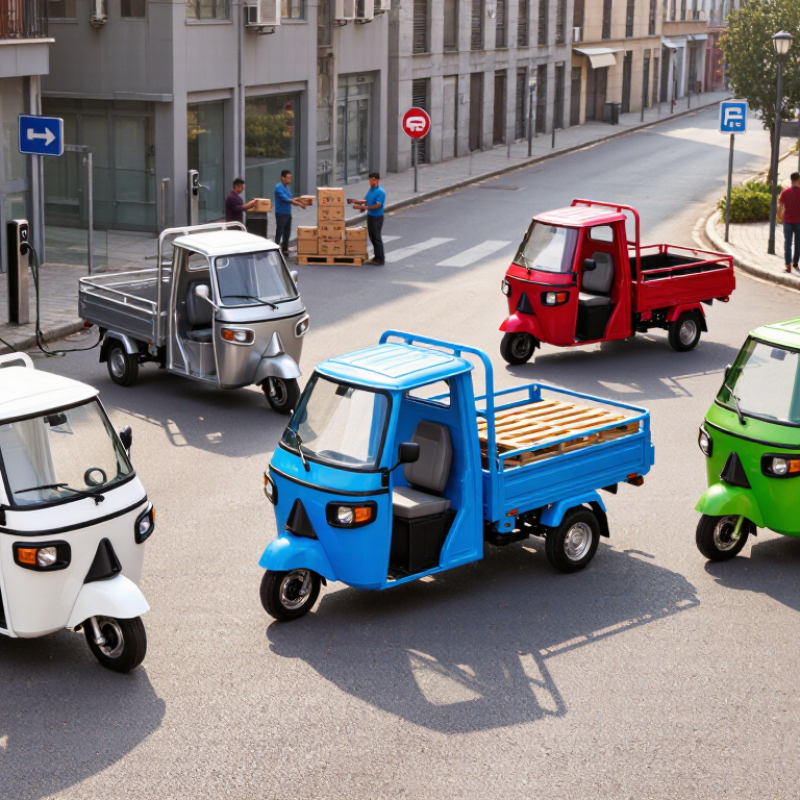
Electric three-wheeler cargo trucks use a simple layout: one front wheel steers, while two rear wheels carry the load. A flat cargo bed sits above the rear axle. Its frame usually combines steel members with protective panels. This design keeps the vehicle narrow for crowded streets and small loading areas. However, the narrow body can feel less stable during sharp turns or uneven road travel.
The power system includes a battery pack, electric motor, motor controller, and charging unit. The battery sends direct current to the controller. The controller regulates power before it reaches the motor. A throttle signal changes motor speed smoothly. In many models, the motor drives the rear axle through a differential. This allows both rear wheels to rotate at different speeds during a turn. Some systems also recover limited energy during braking.
Real-world performance depends on more than motor output. Battery condition, tire pressure, cargo weight, and road slope all matter. I have found that uneven loading can change steering behavior noticeably. Keep heavy items low and close to the axle. That detail is easy to overlook. Brakes, suspension joints, wiring, and battery ventilation need regular inspection. The ideal design rarely exists. A truck suited to flat warehouse routes may perform poorly on steep roads or rough surfaces. Buyers should test turning stability, stopping distance, charging time, and usable payload under realistic working conditions.
Choosing among the five best electric three-wheeler cargo trucks requires more than comparing battery size.
Payload capacity comes first. Measure the real load, including tools, packaging, and passengers. A truck rated for 800 kilograms may handle poorly on steep roads when fully loaded. Check the cargo bed length, side-wall height, turning radius, and ground clearance. These details matter beside crowded markets and narrow delivery lanes.
Battery capacity should match the daily route, not advertising claims. The International Energy Agency’s Global EV Outlook 2024 reports nearly 600,000 electric three-wheeler sales in India during 2023, showing strong commercial demand. Compare usable kilowatt-hours, charging time, battery warranty, and expected cycle life. A removable battery can help small operators. Fast charging sounds attractive, but it may require costly electrical upgrades. Sometimes, a slower overnight charge works better.
Motor torque, braking, suspension, and service access deserve equal attention. Electric motors should pull steadily on ramps, especially with a wet cargo floor and uneven weight. The U.S. Department of Energy notes that cold conditions can reduce electric vehicle range by up to 40%. Leave a practical range buffer. I would not trust laboratory range alone. Test one vehicle on your real route, with your usual load, before ordering several. Check diagnostic support, spare-part availability, and downtime records. A cheaper truck can become expensive when one controller waits weeks for replacement.
Five Leading Electric Three-Wheeler Cargo Truck Options
Electric cargo three-wheelers are becoming practical tools for short urban deliveries. The International Energy Agency reported nearly 580,000 electric three-wheeler sales in India during 2023. That growth reflects lower running costs, dense delivery routes, and improving battery supply. The ranking is not absolute.
The first option is a compact box carrier for groceries and parcel routes. It protects cargo from rain and uses narrow streets efficiently. A flatbed model suits construction supplies, produce, and removable containers. A tipper version handles sand, waste, and landscaping materials. Refrigerated cargo models serve food and medicine deliveries, but insulation reduces usable space. Finally, a long-range modular truck fits operators covering multiple daily zones. Swappable batteries can reduce waiting time, although they require compatible infrastructure.
Tips: Check payload after battery weight, not only the advertised figure. Measure the loading floor beside your largest crate. Ask for verified range under full load and frequent stops. The Global EV Outlook 2024 also highlights charging access as a major barrier to electric-vehicle adoption. Therefore, depot charging may matter more than peak motor power. I would test hill performance with real cargo. Laboratory numbers can look impressive, yet traffic, heat, and overloaded routes change results. A useful comparison should include warranty terms, brake durability, service response, and battery replacement costs.
Payload, Range, Charging, and Operating Cost Comparison
The best choice depends on the delivery route, not the brochure. A compact box truck suits dense streets, carrying about 300–500 kilograms with an advertised range of 80–120 kilometers. A flatbed version usually handles 500–800 kilograms, but its open load can reduce efficiency in strong wind. These figures are practical market ranges, not certified standards. The IEA’s Global EV Outlook 2024 identifies electric three-wheelers as a leading electrification segment in emerging urban markets.
For heavier work, a tipper model can carry roughly 500–1,000 kilograms, while an insulated cargo body often manages 400–700 kilograms. Refrigeration consumes energy continuously. Expect a shorter working range. A long-range fleet model may offer 100–160 kilometers, using a larger battery and higher purchase cost. Charging commonly takes four to eight hours on standard AC equipment. Fast charging is not universal. That matters.
Energy cost can look attractive. A vehicle using 15 kWh per 100 kilometers costs about $2.25 at $0.15 per kWh. This is an illustrative calculation, not a market average. The ICCT’s electric-truck efficiency research supports evaluating energy use per kilometer, rather than relying on battery size alone. Buyers should request tested range at full payload, including hills, rain, and driver weight. Payload claims sometimes exclude those details. The Global EV Outlook also stresses local charging access and duty cycles. A missed charging window can erase the savings. Tire wear, battery replacement, insurance, and downtime still need careful pricing.
Choosing among five electric three-wheeler cargo trucks requires more than comparing battery size. Start with your route. Measure daily distance, average payload, road gradients, loading times, and parking conditions. The International Energy Agency’s Global EV Outlook 2024 reported over 580,000 electric three-wheelers sold in India during 2023. That growth reflects practical urban demand, not only environmental interest. A compact cargo box suits narrow streets, while a longer platform helps with produce, parcels, or hardware. Confirm the rated payload, not the marketing maximum.
Tips: Build a one-week route record before buying. Include traffic delays and return trips.
Battery capacity should match real usage, with reserve power for weather, hills, and detours. Ask for tested range under payload, not an empty-vehicle figure. Charging time matters when the truck makes two shifts. Check battery warranty terms, replacement cost, charger safety, and local service coverage. The International Council on Clean Transportation’s urban freight research repeatedly links operating efficiency with payload, utilization, and charging access. Calculate energy cost per delivery, tyre wear, maintenance, and driver time. A cheaper truck can become expensive when downtime grows.
Tips: Compare total cost over three years. Keep one charging backup plan. Bigger batteries are not automatically better. They add weight, cost, and charging demand. I would also test the turning radius personally; brochures rarely show how difficult a crowded loading lane can feel.
USA / Americas
1507 Capital Ave, Suite 102
Plano, TX 75074
+1 (214) 838-7010
8:00am – 5:00pm (GMT-6)
Australia / Asia Pacific
503 Cross Keys Rd,
Cavan SA 5094
+61 8 7200 3909
9:00am – 5:00pm (ACDST)
© 2025 Green Frog Systems. | Privacy Policy | Terms & Conditions


